
Iroquois County Court Records After a Jail Arrest
Once someone is arrested and booked in Iroquois County, the case does not begin in court right away. Booking creates the jail record. The court record starts when the State's Attorney reviews the arrest and files charges. Those filed charges open a criminal case, and that case becomes the official court record after the arrest. Court records hold the charges, court dates, release or detention orders, and the final disposition. They live with the Iroquois County Circuit Clerk in the 21st Judicial Circuit, not at the jail.
The arrest side and the court side answer different questions. For who is in custody right now, the jail inmate records page covers the roster and booking detail, and the jail mugshots page covers booking photos. The court record is separate. It reflects the charges the prosecutor actually filed, which can differ from the offense listed at booking. To trace what happened after an arrest, the filed court case is the stronger source. The jail line and records requests cover only the early custody snapshot.
The office that holds these files is the Iroquois County Circuit Clerk, led by Circuit Clerk Lisa Hines.
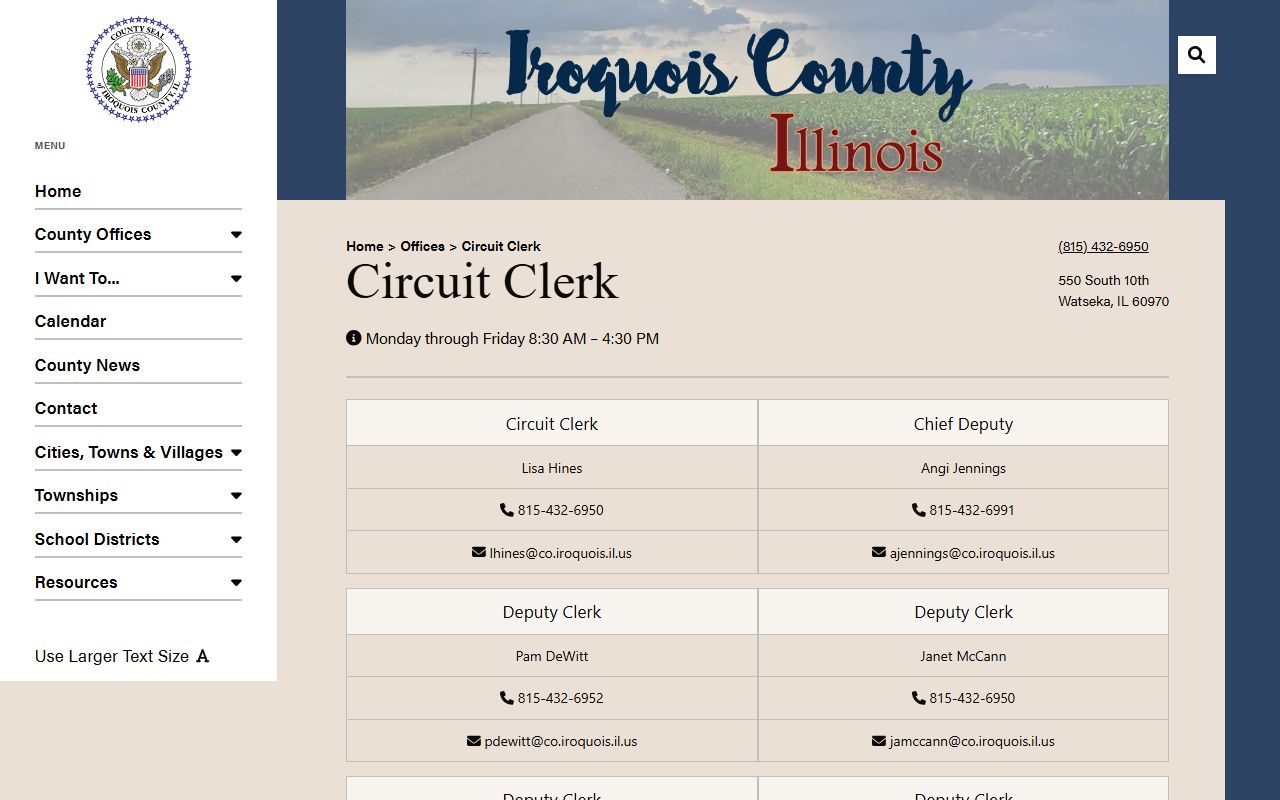
The clerk keeps every Circuit Court record and collects court fines and fees, so it is the index behind any case search after an arrest.
How to Find Iroquois County Court Records After an Arrest
The online case search for Iroquois County runs on Judici. Illinois Courts links it as the court's online records option, though Judici operates the site and is not the court itself. The Circuit Clerk holds the master index behind it. Arrest and booking details stay on the jail roster, so a court search shows the filed charges and case status, not the moment-by-moment custody picture.
- Open the Judici Iroquois County portal and choose case search.
- Clear the hCaptcha challenge on the page, then open the case-search form.
- Search by defendant name, entered in Judici's Last, First Middle initial format, or by case number.
- Open the matching case and read the charges, current status, and docket history.
The Judici case-search page is where names and case numbers go after the security challenge clears.
A case page usually lists the defendant name and case number, the charges and their class, the docket of hearings, any release or detention order, and the disposition. Older or closed cases may not appear on Judici, since the online coverage can carry date limits. For those, the Circuit Clerk's office at 815-432-6950 is the place to ask.
That page is the practical front door to court records after an arrest in this county. A court file is not the same as a statewide criminal history, though. Formal criminal-history records come from the Illinois State Police, not the circuit clerk. The split is worth repeating: court files show filed charges and dispositions, while jail records show booking and custody.
How Iroquois County Charges Get Filed After an Arrest
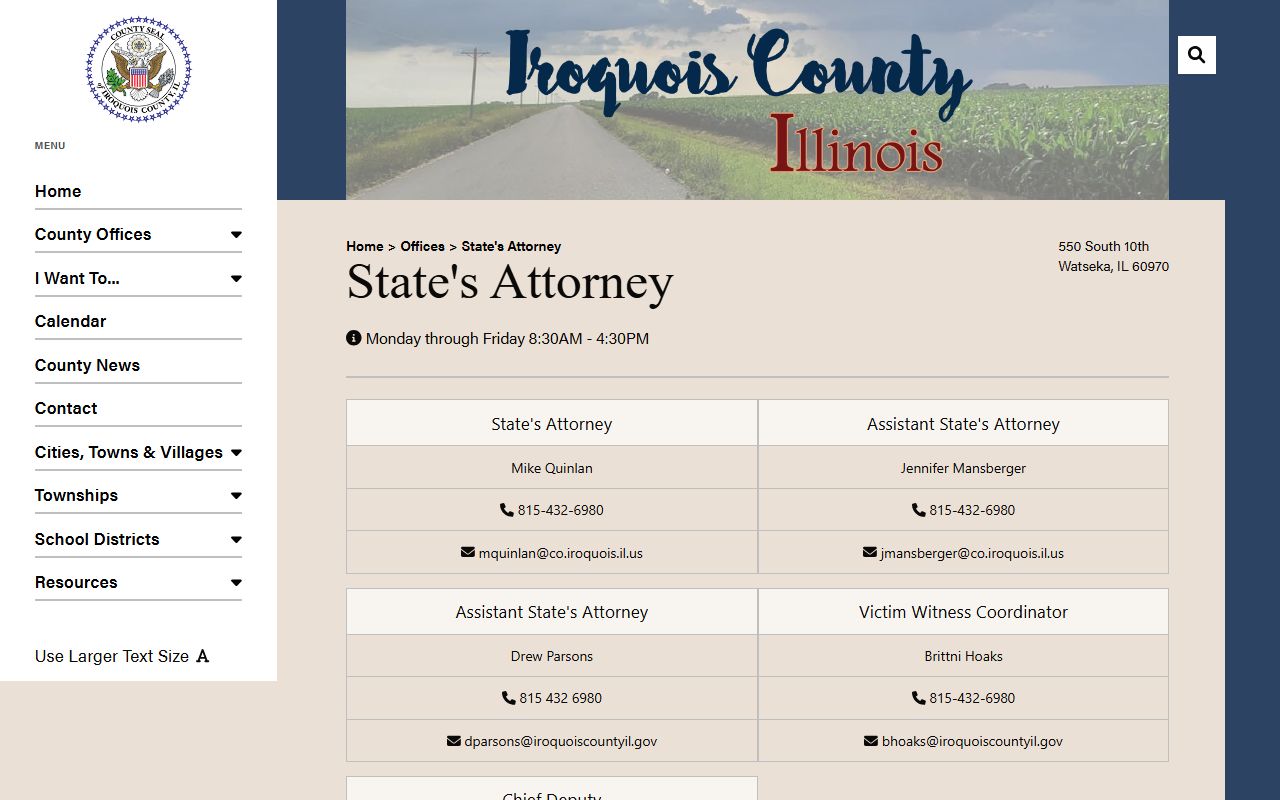
Charges do not appear by magic after an arrest. The sequence is steady. An officer makes the arrest, the person is booked at the jail, and then a charging document is filed to start the court case. In Iroquois County that filing decision rests with State's Attorney Mike Quinlan and the assistant prosecutors in his office. The prosecutor decides what to charge, whether to seek detention, and whether to amend or drop a charge later. Three charging documents are common.
| Complaint | Information | Indictment | |
|---|---|---|---|
| Filed By | Officer / Prosecutor | Prosecutor | Grand Jury |
| Common For | Misdemeanors | Many felonies | Serious felonies |
| Starts | The case | The case | The case |
The choice of document depends on the offense and the stage. The Iroquois County State's Attorney reviews each arrest before charges are filed.
A misdemeanor often moves on a complaint, while a felony usually proceeds by information or grand jury indictment. Either way, the filing is what turns an arrest into a court record.
What Iroquois County Charge Status Means
A charge is not frozen once it is filed. As a case moves, the status changes, and the court record tracks each step. The offense written at booking can differ from what the prosecutor files, and the filed charge can shift again before the case ends. Reading the status column on a case is how a court record shows where things stand. The common labels are short, but each carries a specific meaning.
| Status | What It Means |
|---|---|
| Pending | The charge is filed and the case is active, with no final outcome yet. |
| Amended / Reduced | The prosecutor changed the charge, often to a different or lesser offense. |
| Dismissed | The court dropped the charge, ending it. |
| Nolle Prosequi | The prosecutor declined to pursue the charge or withdrew it. |
Note: A booking charge listed at the jail is only a starting point, and it can read differently from the charge that finally appears in the court record.
Release and Detention After an Iroquois County Arrest
Illinois no longer uses cash bail. The Pretrial Fairness Act, part of the SAFE-T Act, took effect on September 18, 2023, and it changed how release works after an arrest. Under 725 ILCS 5 Article 110, release is presumed and set through non-monetary conditions. Detention is the exception. The State must petition the court, and a judge can order someone held only after a detention hearing finds statutory grounds. Sheriff Perzee has described the local effect plainly. Detainable offenses go to the State's Attorney for a detention hearing, while non-detainable offenses get a notice to appear. A separate hold or detainer can still keep someone in custody.
| Release Path | How It Works |
|---|---|
| Non-monetary release | The court sets conditions without cash; no money is posted to get out. |
| Conditions of release | Curfew, check-ins, no-contact orders, and similar court-ordered terms. |
| Detention petition | The State asks the court to detain a person on a qualifying charge. |
| Detainer / hold | Another agency's hold blocks release even when the local charge would not. |
The shift was visible locally. After no cash bail began in September 2023, county officials reported the jail population dropping into the low teens, with people accused of non-detainable offenses released on a notice to appear. The court record, not a bond receipt, is now where the release conditions and any detention order are documented. To read those orders, search the case rather than calling the jail about posting money.
Warrants That Lead to an Iroquois County Arrest
A warrant is a court order that can put someone under arrest, and it often ties back to a case already on file. Iroquois County does not publish an online warrant search or a most-wanted page. To check on a possible warrant, call the Sheriff's Office at 815-432-6992 or the jail at 815-432-6970, though staff may limit what they share. A bench warrant usually links to an existing case, so a Judici case search can surface it. The Circuit Clerk at 815-432-6950 can answer court-record questions, and VINE handles custody notifications. The main warrant types break down like this.
- Arrest warrant
- A court order authorizing police to take a person into custody.
- Bench warrant
- Issued by a judge, often after a missed court date or a violated order.
- Search warrant
- Authorizes a search of a place or person; it is not a custody listing.
- Fugitive warrant
- A warrant or hold from another jurisdiction.
Charges vs. Convictions
An arrest and a charge are accusations. A conviction is an outcome. The two sit at different points in a case, and a court record shows both as it develops. A charge means the prosecutor believes there is probable cause. A conviction means guilt was proven beyond a reasonable doubt, by plea or verdict. Both stay part of the public court record, but they carry very different weight.
| Charge | Conviction | |
|---|---|---|
| Stage | Accusation | Verdict or plea |
| Burden of Proof | Probable cause | Beyond a reasonable doubt |
| Public Record | Yes | Yes |
Sealed vs. Expunged Court Records After an Arrest
An arrest that ends without a conviction does not always vanish from the court record on its own. Illinois lets eligible people clear qualifying records through sealing or expungement under 20 ILCS 2630/5.2. The two are not the same. Sealing hides a record from most public view but keeps it within limited reach. Expungement goes further and treats the record as if it never existed. Eligibility depends on the offense and the outcome, and the statute sets the categories for each.
| Sealed | Expunged | |
|---|---|---|
| Visibility | Hidden from public | Destroyed / treated as never existed |
| Law Enforcement | Limited access | Very limited |
| Eligibility | Set by category under 20 ILCS 2630/5.2 | Set by category under 20 ILCS 2630/5.2 |
Background Checks and Court Records
Court records turn up in two very different kinds of lookups. A formal background check run for employment, housing, or credit must follow the Fair Credit Reporting Act, which sets accuracy and dispute rules. A casual name search on a court portal does not. The information may look similar, but only an FCRA-compliant report can lawfully be used for those decisions. Treat a quick court-record search as informal, not as a vetted screening.
Important: This site is not a consumer reporting agency under the FCRA, and nothing here may be used to decide employment, housing, credit, insurance, or any FCRA-regulated purpose.
Restricted Iroquois County Court Records After an Arrest
Not every court record after an arrest is open. Some are restricted by law. Juvenile cases are confidential. Sealed or impounded files drop out of public view, and dismissed charges may be withheld once a record is cleared. Ongoing investigations stay closed while they are active. For law enforcement records held by county agencies, 5 ILCS 140/7 lists FOIA exemptions that protect investigations, safety, and security. One caution matters here. Illinois FOIA does not reach court files the way it reaches executive agencies, so a county FOIA request is not the route to a court case. Court records come through the clerk or Judici instead.
The Illinois Courts directory for the Iroquois County Courthouse points to the right access channels.
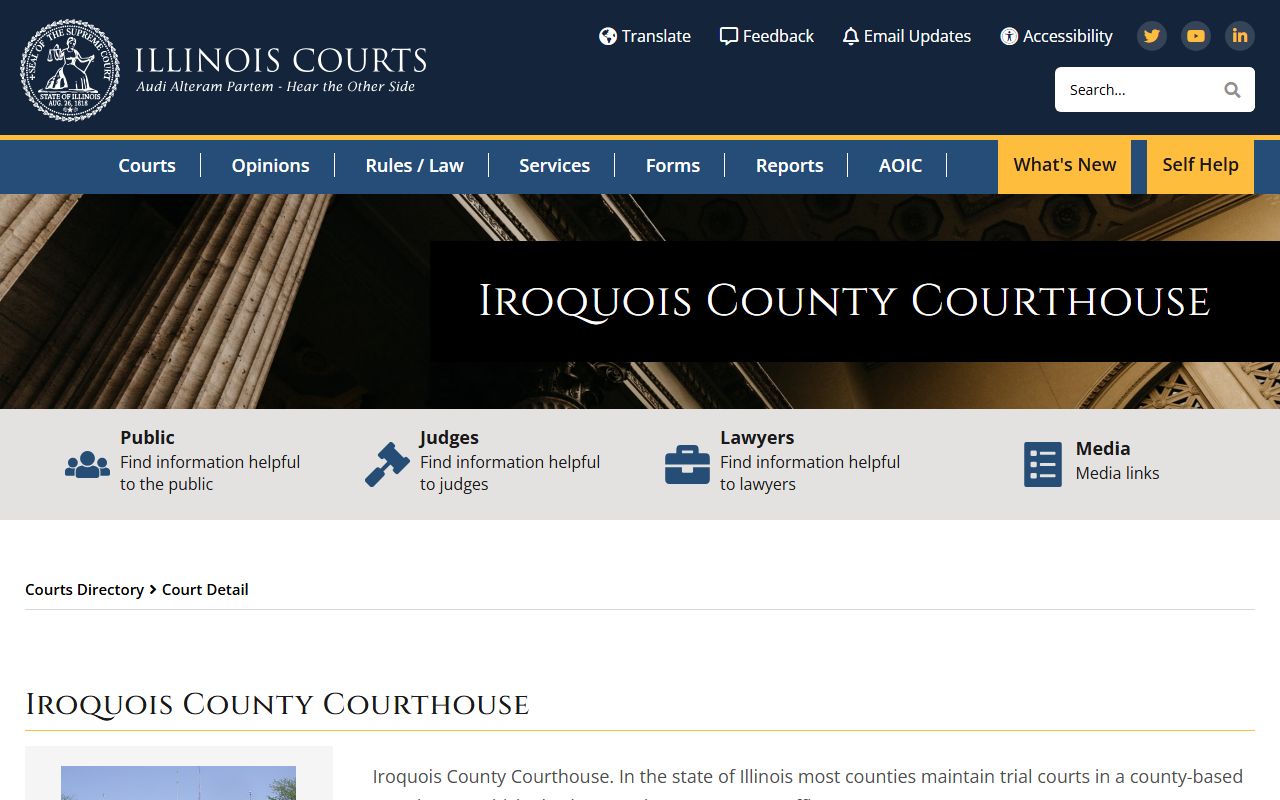
It confirms the courthouse address and hours and links the online case search, which is the proper door for filed court files.
Note: When a record has been sealed or expunged, it may no longer appear on the public case search even though the case once existed.